


Wedding decorations with artificial flowers, made yourself
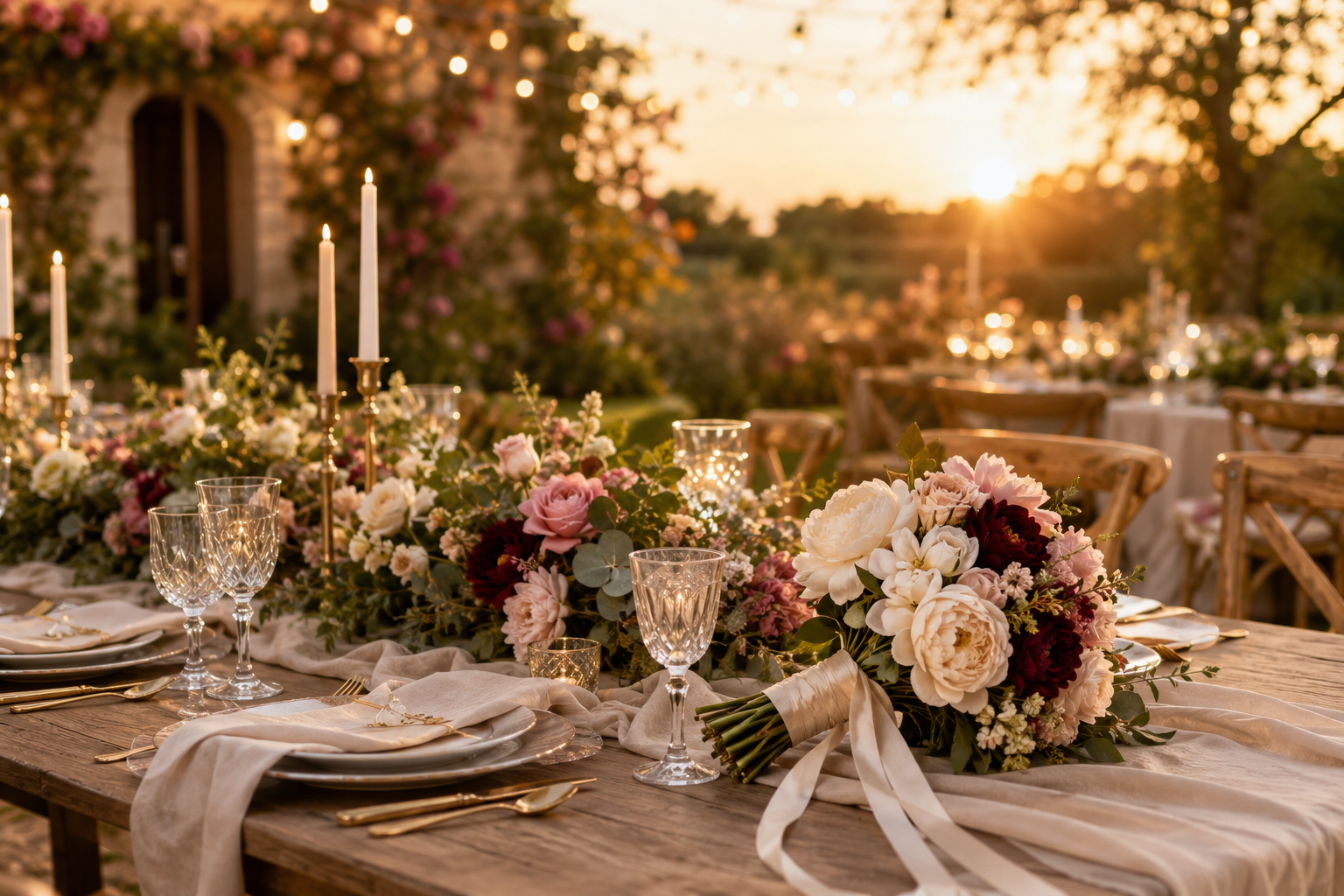
Flowers are one of those items that grow beyond the plan at a wedding: the bridal bouquet, table arrangements, church or ceremony decoration, the reception. Artificial flowers are an option here that above all brings one thing: predictability. This article shows how to use them sensibly and where their limits lie.
What to budget for
So the numbers do not stay vague, here are the usual orders of magnitude at a florist: a bridal bouquet starts at around 70 euros in a simple version, sits at about 90 to 120 euros in the standard version, and quickly reaches 150 to 200 euros for elaborate shapes (cascade, teardrop, hanging roses). The price comes less from the material than from the time it takes to tie.
Add table decoration, the ceremony area and the reception, and the total wedding floristry for a medium-sized celebration quickly reaches 1,500 euros. In wedding forums, exactly this is the recurring topic: not whether flowers are beautiful, but how wide the gap between two quotes can be.
On top of that comes a factor that is rarely planned for: cut flowers are seasonal goods. Peonies in October or tulips in August cost extra or cannot be had at all.
What speaks for artificial flowers
- Preparation without time pressure. You can tie and arrange weeks in advance. Nothing wilts, nothing has to be finished the night before.
- Independent of the season. Peonies in October or tulips in August are no problem and carry no surcharge.
- Unbothered by heat. Between getting dressed, the ceremony, photos and dancing, twelve hours can easily pass in which the bouquet is out of water. A summer wedding in a marquee is additionally hard on cut flowers, and you can see it in the evening photos. Artificial flowers look at midnight the way they did at ten in the morning.
- Reusable afterwards. Table arrangements move into the living room after the party, to friends, or to the next celebration. Ten years on, the bridal bouquet is still on the shelf instead of existing only in a photo.
- Predictable. The price is fixed at purchase and does not depend on daily rates or availability.
- Try it first. You can hold the bouquet weeks beforehand, hold it up against the dress, photograph it and retie it if need be. With a florist, you see it finished for the first time on the morning of the wedding.
What real flowers do better
- They have scent. That cannot be replaced.
- Up close, for instance with the bridal bouquet in hand, the difference is noticeable on careful inspection. In photos at normal distance it barely shows. That does not make it invisible.
- For some couples, transience is part of the occasion.
Many couples combine the two: the bridal bouquet from real flowers, everything else artificial. That keeps the effort small without giving up scent on the most important bouquet.
A point hardly anyone thinks of
If guests with hay fever come, and with fifty guests that is statistically almost certain, they sit in pollen all evening with cut-flower decorations. Lilies, chrysanthemums and sunflowers are particularly unpleasant here. Artificial flowers release no pollen. Allergic guests have no symptoms and do not even have to bring up their allergy.
What you actually need
A list for a celebration with around 50 guests:
- Bridal bouquet: 12 to 18 stems, depending on the size you want.
- Buttonholes: two to three small blooms each for the groom and the witnesses.
- Table decoration: one small arrangement per table, or three to five single stems in vases. With five tables, that means five units.
- Ceremony area: two larger arrangements left and right.
- Reception: one or two arrangements for the drinks and gift tables.
What that costs depends heavily on the type of bloom, size and quality. It makes sense to work through this list for your own celebration first and then compare offers, rather than planning with blanket figures.
Tying them yourself: how to go about it
- Settle on a colour concept. Two to three colours plus green is enough. More quickly looks restless.
- Order material early. That leaves time to reorder if colours differ.
- Build a test piece. Finish one table arrangement completely, photograph it, judge it. After that you know how much material one unit really takes.
- Produce calmly. Two to three weeks beforehand, spread across several evenings.
- Plan the transport. Put finished arrangements in boxes with dividers so nothing slides around.
Six notes from practice
- Work denser than you think. Arrangements set too loosely look thin in photos. Reckon with around a fifth more blooms than you first estimate.
- Vary the heights. Stems cut to the same length look artificial.
- Work in greenery. Eucalyptus or fern takes the stiffness out of an arrangement and is the detail that most often decides between natural and artificial.
- Keep table arrangements low. Above eye level they get in the way of conversation at the table.
- Choose muted tones. Pastel and cream look calmer in photos than strong colours.
- Heavy blooms at the bottom. That gives the arrangement stability and looks more natural.
How long they last
After the celebration, artificial flowers store away dust-free in a box and can be set up again later. In normal indoor use they keep their shape for a long time. Constant direct sunlight fades colours over time, which is true here as for any decoration.
Suitable material
Ready-tied versions can be found among the bouquets, single stems for free combining under Single stems. Matching vessels are under Vases & decor. If something specific is missing, write to Bloomli via the wish box.
Matching products in the shop

Deluxe Decorative Heart on Stand, Red-Burgundy-White, Height approx. 15 cm
€29,95 incl. VAT

Jungle Duo: Monstera (Monstera deliciosa) and Alocasia Polly with Vibes Fold Green Cover Pots
€70,95 incl. VAT

Colourful Leaf Duo: Croton (Codiaeum variegatum) and Caladium
€52,95 incl. VAT

Colourful Windowsill Duo: Wax Plant (Hoya) and Tradescantia with Yellow and Red Cover Pots
€56,95 incl. VAT

Green Windowsill Duo: UFO Plant (Pilea) and Philodendron Birkin with elho Jazz Round White Cover Pots
€56,95 incl. VAT

Windowsill Orchid Duo Orange and Lilac (Phalaenopsis) with Yellow and Lilac Cover Pots
€78,95 incl. VAT

Pastel Windowsill Duo: Polka Dot Begonia (Begonia maculata) and Ice Water (Pilea cadierei) with Pink and Lilac Cover Pots
€56,95 incl. VAT

Glass Vase "Artic" Ivory, Height approx. 35 cm
€82,95 incl. VAT

Green Duo: Fiddle-Leaf Fig (Ficus lyrata) and Pothos (Epipremnum aureum) with Ocean Atlantic Blue Cover Pots
€60,95 incl. VAT

Trailing Plant Duo: Ivy (Hedera helix) and Tradescantia with Green and Lilac Cover Pots
€56,95 incl. VAT

Eagle Candle Holder, Height approx. 46 cm, Multicoloured
€114,95 incl. VAT

Elephant Candle Holder in Polyresin, Height approx. 35 cm, Pink/Green
€48,95 incl. VAT